
What a regional sports network is
A regional sports network, or RSN, is a TV channel that buys the right to show one or more local teams inside a defined home territory. Each team negotiates its own local broadcast deal, and the league's national streaming packages are built around those deals rather than on top of them.
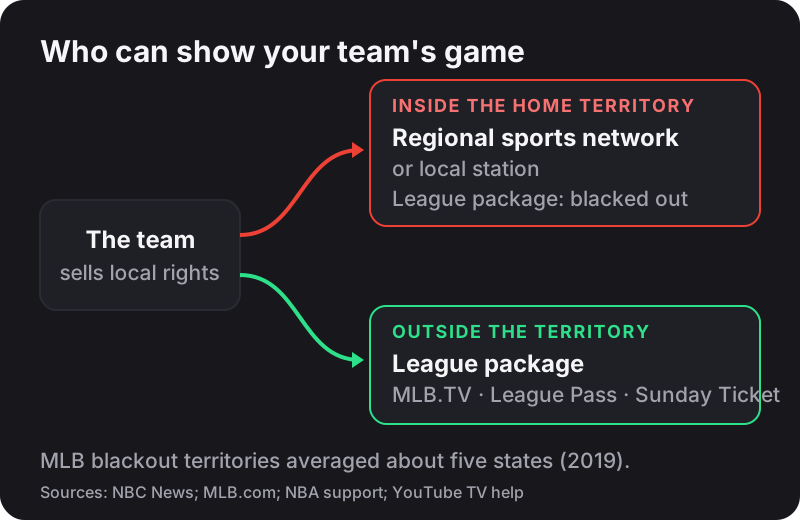
That is the whole reason blackouts exist. A regional network pays for exclusivity: if the same game streamed inside the territory on a league package, the network's channel would be worth less to the cable and streaming services that pay to carry it. NBC News found in 2019 that baseball blackout territories averaged about five states, which is why a fan can live hundreds of miles from the ballpark and still sit inside the zone.
Broadcast games follow the same logic with a different rights holder. In football, the Sunday afternoon games on your local CBS or FOX station belong to that station in your market, so the national package removes them for you. The station, not the league package, is where those games live.
How MLB, the NBA and the NFL decide what you cannot watch
Each league writes its own rules, but they share one principle: the national package carries the games your local rights holder does not. What changes from league to league is which games count as local, and what you can still get when one is blacked out.
| Package | What is blacked out | How your location is set | Still available |
|---|---|---|---|
| MLB.TV | Live games of teams whose territory includes your location; select regular season, special event and postseason games are unavailable in the US | ZIP code of your viewing location; may also use your IP address | Live audio of blacked-out games |
| NBA League Pass (US) | Your local team's games and nationally televised games; playoffs and All-Star Weekend are not live | ZIP code | Local games on demand three days after airing, national games the next morning, and live audio |
| NFL Sunday Ticket | Sunday afternoon games on your local CBS or FOX station; preseason, postseason and national games are not part of the package | Your current viewing area | Out-of-market Sunday afternoon games on CBS and FOX |
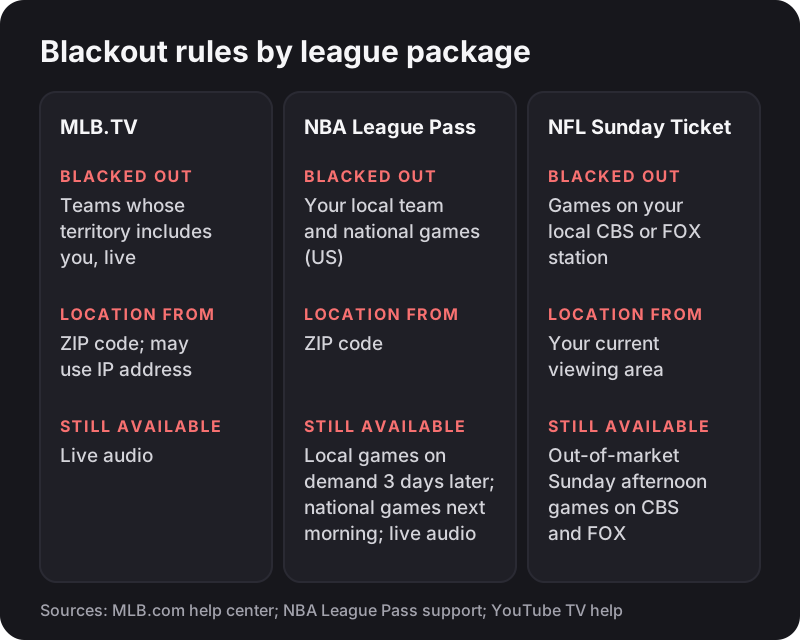
The pattern to notice is that none of these packages is designed to show your home team live: they are out-of-market products. Baseball now adds a separate product for that, because MLB sells in-market streaming subscriptions for 22 of its 30 clubs, club by club, apart from MLB.TV. If you follow the team you live near, the package is the wrong tool however much it costs; if you follow a team elsewhere, it is exactly the right one.
National games are a separate category. When a broadcaster holds a game for the whole country, the package has nothing to sell for it anywhere, which is why MLB.TV lists select regular season, special event and postseason games as unavailable in the US and why League Pass blacks out nationally televised games for every subscriber, not only those near the home team.
Football is the clearest case. Sunday Ticket exists for the games your local stations do not air, and the games they do air stay with them. Primetime games sit with national broadcasters and are not in the package at all, so a Sunday Ticket subscriber in the home market still watches the local game on the local station.
Why your ZIP code decides it
Your location decides it because rights are sold by territory, and each package checks where you are before it shows a game. MLB.TV asks for the ZIP code of your viewing location and says it may also use factors such as your IP address; League Pass ties blackouts to your ZIP code, and Sunday Ticket to your current viewing area.
For broadcast games, the territory is your TV market. Nielsen divides the country into 210 designated market areas and assigns every county to exactly one of them, based on which city's stations people in that county watch most. Those markets follow viewing habits rather than state lines, so two neighbors in different counties can see different games.
Because the check uses where you are rather than where your team plays, the answer can change when you travel. MLB says its restrictions depend on where you physically are, so a fan away from home may find the home team available on the package, while a visitor to that city finds the same games blacked out. Nothing about the subscription changed; the location did.
Baseball territories are drawn by the league and its teams rather than by Nielsen, which is why a blackout zone can stretch far beyond one TV market. The practical answer is the same either way: MLB and the NBA both publish a ZIP code lookup, and checking your own ZIP code before you pay for a package takes a minute.
What blackouts mean for any IPTV service
Blackouts apply to every service that has paid for the games it shows, IPTV included. The restrictions are written into the rights agreements, so a provider that carries a league's games under license inherits the league's rules in your area, exactly as a cable company or a live TV streaming bundle does.
That gives you a simple test. A provider that advertises your home team's games inside your own market, without the regional network that holds them, is telling you it does not hold those rights. Our IPTV licensing explainer covers what actually happens to subscribers when a service like that is taken offline, and the money is rarely the largest loss.
The same logic explains why an honest service lists its limits instead of hiding them. Regional blackouts are one limit; local channel coverage is the other, because local stations are also licensed market by market. Both come up again and again across our IPTV guides, and both are questions to ask before you pay anyone.
Legitimate ways to watch a blacked-out game
The legitimate fix is to watch on whoever holds the rights where you live, or to use what the league still allows during a blackout. There are four routes, and most fans need only one of them.
Subscribe to the regional network. Your local team's games are on the network that holds them, which is carried by cable, satellite and some live TV streaming bundles. Check which service carries your team's network in your ZIP code before you sign up for anything.
Use an antenna for broadcast games. Football games on your local CBS or FOX station, and any game a local station airs, come free over the air. Our guide to local channels walks through the FCC's antenna advice step by step.
Check for an in-market subscription. For 22 of MLB's 30 clubs, MLB sells an in-market streaming subscription that carries the local broadcasts without a blackout; it is sold separately from MLB.TV, and the price depends on the club.
Listen live, or watch later. MLB.TV includes live audio of blacked-out games, and NBA League Pass offers live audio and puts local games on demand three days after they air.
Skip the workarounds. The packages check your location precisely because the territories are part of the deal, and any method that disguises where you are is something the league does not offer and the rights holder has paid to prevent. It also leaves you exposed if the method stops working halfway through a season.
Buy the package for what it is built for. If you follow a team outside your area, the national package is exactly right; the blackout only bites on the team you live near.
Whatever you choose, budget for in-market games as a sports cost rather than a TV cost. A general entertainment subscription, ours included, does not replace the rights holder for your home team. If you want everything else on one bill, compare the four NixaTV plans, and keep the regional network for the games that matter most to you.